Image courtesy of Christie’s
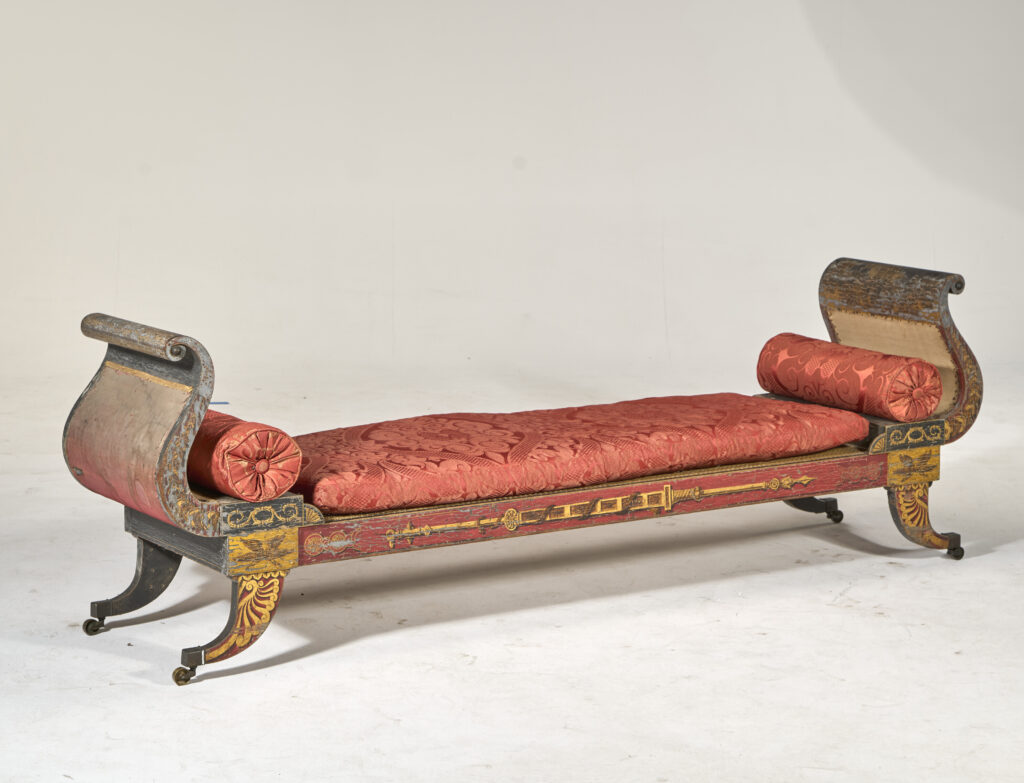
The Schrimsher Foundation today announced the acquisition of The Bernard-Robb Family Classical Parcel-Gilt Paint-Decorated Poplar and Maple Grecian Couch, a rare and important example of early American Classical furniture sold at Christie’s in New York as a part of their “We the People: America at 250” sale. Created circa 1815 after a design by Benjamin Henry Latrobe (1764–1820) and attributed to the preeminent Baltimore painted furniture makers John and Hugh Finlay, the couch enhances the Foundation’s distinguished collection of American Classical furniture and decorative arts.
Executed in poplar and maple with exuberant parcel-gilt and painted decoration and its original patterned red upholstery, this exceptional Grecian couch demonstrates the refined aesthetic and artisanry of the Classical period in the United States. Its design reflects the ideals of Latrobe, a seminal figure in Classical American architecture, as well as the pattern books of Charles Heathcote Tatham and Percier & Fontaine, and the skill of the artisans who worked in the Finlay workshop, all (including many women) important contributors to the visual culture of the early Republic.
“This acquisition deepens our commitment to preserving and advancing the study of American Classical furniture,” said Randy Schrimsher, cofounder of the Schrimsher Foundation. “The piece enriches the collection and invites fresh research into the interplay of design, art, materials, craft, and cultural exchange that defined early 19th-century American decorative arts.”
The Schrimsher Foundation is grateful to Peter Kenny, formerly of the Metropolitan Museum of Art, and Alexandra Kirtley of the Philadelphia Museum of Art, who will advise and guide the conservation of the couch. The Foundation’s goal is to stabilize the object and, in collaboration with conservators, investigate its original paint decoration, structure, and upholstery. In its extraordinary condition, the couch has the potential to reveal significant new information about Baltimore’s famed Classical painted furniture tradition. Findings from this research will inform the creation of a replica intended to illuminate the couch’s original appearance and significance. The project’s progress will be documented and shared publicly on the Foundation’s website.